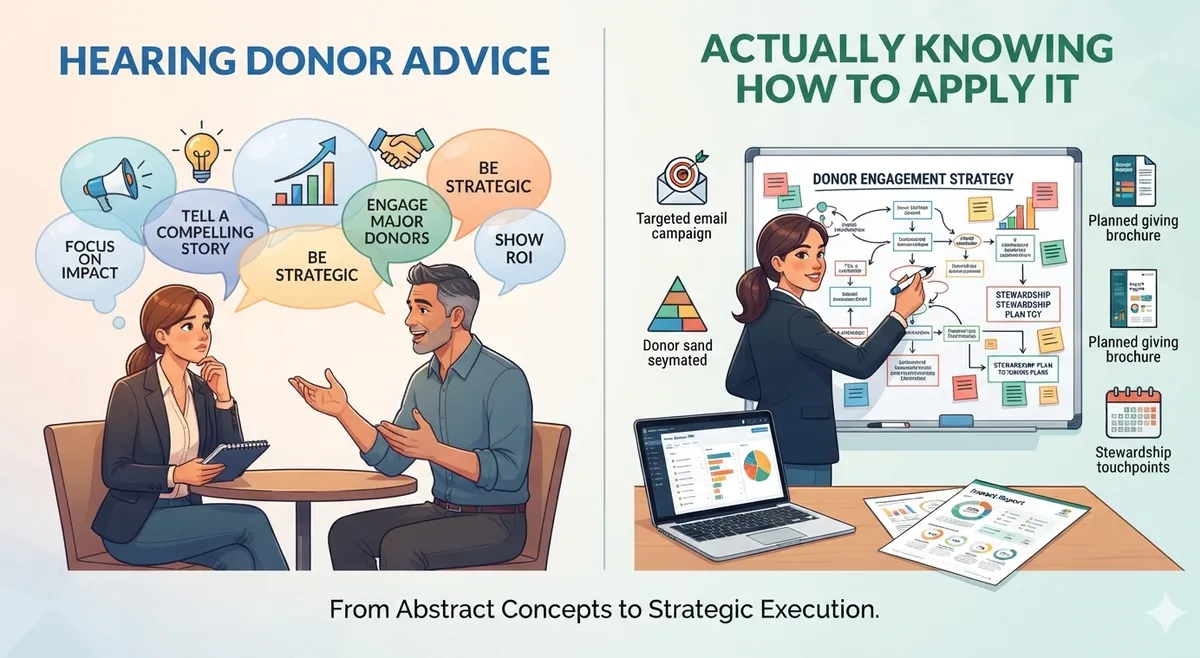
The Difference Between Hearing Donor Advice and Actually Knowing How to Apply It
The Difference Between Hearing Donor Advice and Actually Knowing How to Apply It
Advice Is Easy to Hear but Harder to Use
Fundraising advice is everywhere, and most nonprofit professionals have heard plenty of it throughout their careers. People regularly say that organizations should build relationships, communicate impact, personalize outreach, and focus on donor retention. While these recommendations are valuable, simply hearing them does not automatically create better fundraising results. The real challenge begins when it is time to translate broad advice into decisions, conversations, systems, and daily actions. Knowing that donor relationships matter is very different from knowing exactly what to say when reconnecting with a supporter who has not given in two years. Understanding this difference has become one of the most important themes I explore through conversations and lessons shared on Hey Fundraiser.
The fundraising world often treats knowledge as if exposure alone creates expertise. Someone attends a conference session, listens to an experienced fundraiser, reads an article, or hears a successful leader explain what worked for them. They may leave feeling inspired and informed, yet still struggle when they return to their own organization. This happens because information without context does not always provide a clear path to execution. Every nonprofit has different donors, resources, missions, internal structures, and challenges that influence how advice should be applied. The goal should not simply be to collect more fundraising wisdom but to develop the ability to interpret that wisdom and adapt it to real situations.
General Principles Need Specific Context
Many fundraising principles sound simple because they are usually expressed in broad and universal language. For example, a fundraiser might hear that donors want to know the impact of their gifts. That statement is true, but it does not explain what type of impact story should be shared, when it should be communicated, or which donors should receive which message. It also does not address how to communicate impact when an organization cannot easily measure outcomes or when a program takes years to produce visible results. The principle is useful, but the application requires additional thinking and professional judgment. This is where the gap between hearing advice and actually knowing how to use it becomes clear.
The best fundraising professionals learn to ask questions that move beyond the original piece of advice. They consider the audience, timing, communication channel, donor history, organizational capacity, and desired outcome. Instead of asking whether a particular fundraising strategy works, they ask under what circumstances it works best. They also recognize that successful strategies often require adjustments before they can fit a different organization. A major gift technique used by a large university may not work exactly the same way for a small community nonprofit. Real expertise comes from understanding the principle deeply enough to adapt it without losing its purpose.
Experience Helps Turn Ideas Into Decisions
Experience plays an important role because fundraising rarely follows a perfectly predictable formula. A donor may respond positively to an invitation that another donor ignores completely. A stewardship message that feels personal to one supporter may feel unnecessary or poorly timed to someone else. Fundraisers therefore need more than a collection of recommended tactics. They need the ability to recognize patterns, assess situations, and make thoughtful decisions when circumstances are unclear. This type of judgment develops through practice, reflection, and exposure to a variety of real fundraising situations.
Listening to experienced professionals can accelerate that learning process, but only when listeners actively examine how those experiences connect to their own work. When I hear a fundraiser describe a successful donor conversation, I do not think the value is limited to repeating their exact words. The greater value often comes from understanding why they approached the conversation in a particular way. What information did they know about the donor, and what signals influenced their decisions? How did they determine the appropriate timing for the conversation? What relationship existed before the ask was made? These questions transform a story about fundraising success into a lesson that can be applied more intelligently.
Copying a Strategy Is Not the Same as Understanding It
One of the most common mistakes in fundraising is copying successful strategies without understanding the conditions that made them successful. An organization may hear about an exceptional campaign and immediately attempt to recreate the same approach. They might use similar messaging, create a comparable event, or adopt the same donor engagement process. When the results are disappointing, they may conclude that the strategy itself was ineffective. In reality, the problem may be that the original strategy depended on circumstances that were never present in the new environment.
Every successful fundraising strategy has a context behind it. A compelling campaign may have benefited from years of brand building and donor trust. A highly effective major gift program may have been supported by strong research, experienced leadership, and a well-developed pipeline. A viral fundraising story may have connected with an audience because of a specific cultural moment that cannot easily be repeated. Understanding context prevents fundraisers from treating strategies like templates that guarantee results. It encourages them to identify the underlying principles and then design an approach that makes sense for their own organization.
Application Requires Critical Thinking
Fundraising advice becomes useful when it is combined with critical thinking. Instead of immediately implementing every recommendation, professionals should evaluate how it fits their current situation. They need to consider what problem they are actually trying to solve and whether the advice addresses that specific problem. Sometimes an organization believes it needs more donors when the real issue is poor retention among existing supporters. Other times, a team may focus heavily on improving solicitation techniques when the deeper challenge is a lack of meaningful donor relationships. Good application begins with accurately diagnosing the situation.
Critical thinking also means recognizing when advice should not be followed exactly as presented. A respected fundraising professional can offer excellent guidance based on years of experience, but their perspective is still shaped by their environment. Their organization may have different resources, audiences, leadership structures, and priorities. This does not make their advice less valuable, but it does mean that interpretation is necessary. The strongest fundraisers are not those who blindly follow every expert. They are the ones who understand enough to determine which ideas are relevant and how those ideas should be modified.
Donor Advice Must Connect to Real Relationships
Advice about donors can become particularly difficult to apply because every donor relationship is unique. It is easy to hear that fundraisers should listen more and talk less during donor conversations. Applying that advice requires knowing what meaningful listening actually looks like in practice. It means preparing thoughtful questions, noticing emotional cues, resisting the urge to immediately redirect the conversation toward an organizational need, and remembering details that matter to the individual. Listening is therefore not simply remaining quiet while another person speaks. It is an active process that requires curiosity, attention, and genuine interest.
The same challenge exists with advice about donor communication. Fundraisers are frequently told to personalize their outreach, but personalization means more than adding a donor's name to an email. Genuine personalization requires understanding what motivates the individual and what relationship they have with the mission. One donor may care deeply about measurable outcomes, while another may be motivated by personal experiences or relationships with people connected to the organization. Applying donor advice effectively means identifying these differences and responding appropriately. That level of understanding cannot always be gained from a checklist because it requires observation and thoughtful relationship management.
Reflection Is Where Learning Becomes Practical
One of the most effective ways to improve the application of fundraising knowledge is through reflection. After a donor meeting, campaign, event, or stewardship initiative, it is important to examine what happened and why. Success should be analyzed just as carefully as failure because positive results can also contain valuable lessons. A fundraiser should ask which decisions contributed to the outcome and which assumptions proved incorrect. They should also consider what they would repeat and what they would change in a similar situation. This reflective process gradually transforms individual experiences into stronger professional judgment.
Reflection also helps prevent fundraisers from constantly searching for the next piece of advice without fully implementing what they already know. The fundraising profession offers an endless supply of books, podcasts, webinars, conferences, and online discussions. While continuous learning is valuable, consuming information can sometimes feel productive without producing meaningful change. The important question is not simply what new idea was learned this week. The more valuable question is how a previously learned idea has changed the way someone works. Through my conversations at Hey Fundraiser, I believe the greatest educational value often comes from helping people think more deeply about implementation rather than simply giving them another tactic to add to their collection.
Questions Create Better Application
When receiving fundraising advice, asking better questions can significantly improve the ability to apply it. Instead of asking whether an approach works, consider why it worked for the person sharing it. Ask what conditions were present before the strategy was implemented and what challenges occurred during the process. Consider how long it took to see meaningful results and whether the organization had resources that others might not possess. These questions reveal the operational reality behind advice that may initially sound simple. They also help separate core principles from details that may only be relevant to one specific situation.
Questions should also focus inward toward the organization receiving the advice. What does the current donor data suggest about the problem? What relationships already exist, and where are the gaps? Does the team have the capacity to implement the recommendation consistently? How will success be measured, and how long should the organization reasonably wait before evaluating results? These questions turn passive learning into active problem-solving. They encourage fundraisers to treat advice as an input for strategic thinking rather than as an instruction manual.
Practice Creates Confidence
There is no substitute for actually practicing fundraising skills in real situations. Someone can listen to hundreds of conversations about major gift fundraising and still feel uncomfortable during their first serious donor meeting. They can understand intellectually that they should ask open-ended questions while still struggling to avoid talking too much. They can learn the principles of storytelling while finding it difficult to create a compelling narrative for their own mission. Knowledge provides the foundation, but practice develops confidence and competence. The transition from understanding to application happens when ideas are repeatedly tested and refined.
Practice does not require waiting for a perfect opportunity or a high-stakes fundraising campaign. Fundraisers can improve by experimenting with smaller changes in everyday interactions. They can test different questions during donor calls and observe which ones create deeper conversations. They can review emails before sending them and consider whether the message genuinely reflects the donor's perspective. They can practice explaining the organization's impact in simple and emotionally meaningful language. Small repetitions create stronger instincts over time and make it easier to apply good advice when more important opportunities arise.
Learning From Others Without Losing Your Own Judgment
The fundraising profession benefits enormously from shared knowledge and open conversations. Experienced professionals can save others from making avoidable mistakes by sharing what they have learned. New perspectives can challenge outdated assumptions and introduce approaches that would otherwise remain undiscovered. Podcasts and professional communities create opportunities to learn from people working in different types of organizations and fundraising environments. This exchange of knowledge is one of the reasons I value creating conversations through Hey Fundraiser. However, the purpose of learning from others should never be to replace independent judgment.
Every fundraiser eventually needs to develop their own ability to assess situations and make decisions. Advice should inform that judgment rather than eliminate the need for it. The goal is not to become a copy of the most successful fundraiser someone admires. The goal is to understand the principles behind successful fundraising deeply enough to use them authentically. When professionals combine external knowledge with their own experience and careful observation, they become more adaptable. That adaptability is especially important in a field where donor expectations, communication habits, and organizational challenges continue to evolve.
Turning Knowledge Into Meaningful Action
The real difference between hearing donor advice and knowing how to apply it is the difference between information and professional capability. Information tells us what might be important, while capability helps us determine what to do next. A fundraiser can know that relationships matter without knowing how to strengthen a particular relationship. They can understand that stewardship improves retention without having a practical system for delivering meaningful stewardship consistently. They can hear that donors should be treated as individuals while still relying on communication that feels generic. Closing this gap requires intentional effort beyond simply consuming more content.
The most valuable learning happens when advice is connected to action, reflection, and adjustment. Listen carefully to experienced professionals, but examine the context behind their recommendations. Test useful ideas in ways that make sense for your organization and evaluate what happens afterward. Learn from both successful and unsuccessful outcomes, and allow experience to strengthen your judgment over time. The fundraising professionals who grow the most are not necessarily the ones who hear the most advice. They are the ones who learn how to transform knowledge into thoughtful action that strengthens real relationships and creates lasting impact.
